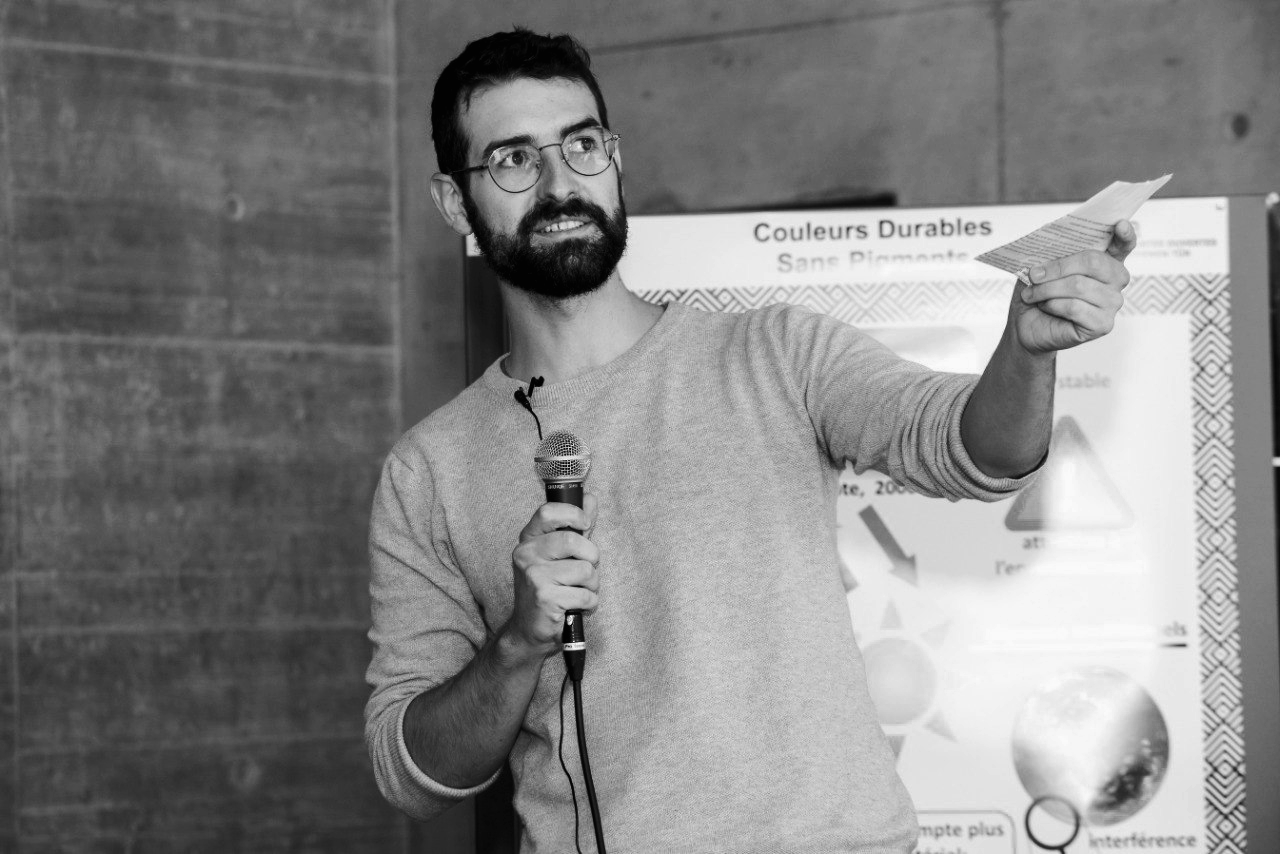
Daniel Borcard
PhD student in conceptual & enterprise modeling for collaborative robotics.
PhD candidate, Digitalization and Information Systems Group, University of Fribourg
About Me
I'm a PhD student specializing in conceptual and enterprise modeling applied to collaborative robotics. I build languages and models that link high-level enterprise architectures down to specialized robotic system behaviors and informations. My work combines Domain-Specific languages, spatial modeling, and process analysis. I aim to bridge process modeling with robotic system design to enable more intelligent, adaptable, and context-aware robots in enterprise and domestic settings.
Conceptual Robotics
Developing semantic models that help robots plan, adapt, and interact more intelligently.
Low/No-code Interaction
Building frameworks for streamlining interaction between humans and robots.
Skills & Tools
A blend of theoretical frameworks and practical systems that enable conceptual modeling, robotic simulation, and deployment.
Conceptual & Enterprise Modelling
Metamodeling
Model-driven engineering and metamodel design.
BPMN
Business Process Model and Notation for process modeling.
UML
Unified Modeling Language for software design.
ER Diagrams
Entity-Relationship modeling for database design.
Robotics & Simulation
ROS/ROS2
Robot Operating System for robotics middleware.
Gazebo
Simulation environment for testing robotic systems.
Python for Robotics
Python development for robotic control and AI.
Process Analysis & Optimisation
Process Mining
Discovering process models from event logs with PM4Py.
OR Tools
Operations research and optimization frameworks.
pandas & NumPy
Data analysis and numerical computing in Python.
Software & Infrastructure
Docker
Container platform for deploying isolated environments.
Git
Version control for collaborative development.
CI/CD
Continuous integration and deployment pipelines.
Web APIs
RESTful APIs for enterprise and robotics tools.
TypeScript
Typed JavaScript for building research tools.
Research Interests
My research bridges conceptual and enterprise modeling with robotics, linking business processes to explainable, traceable robot behavior.
Domain-Specific Languages for Collaborative Robotics
Designing domain-specific languages for collaborative robotics in Industry 4.0 environments, bridging high-level business concepts with robot skills for traceable mappings from processes to robot behaviours.
Human–Robot Interaction in Enterprises
Modelling how humans and cobots share tasks, responsibilities and information flows in business processes, with a focus on collaboration, safety and efficiency.
Task and Motion Planning Integration
Linking task models (BPMN / workflow models) with low-level motion planning to enable automatic generation and verification of robot programs.
Semantic Mapping, Perception & Digital Twins
Connecting perception data to business objects (orders, workpieces, resources) so digital twins and process models remain synchronised with the physical shop floor.
Digital Twins of Processes and Workcells
Developing digital twin models of enterprise processes and collaborative workcells to support monitoring, what-if analysis, and optimisation of human–robot collaboration.
Industry 4.0 & Cyber-Physical Production Systems
Exploring how Industry 4.0 concepts, such as cyber-physical systems, smart factories and connected production networks, can be captured in conceptual and enterprise models for process optimisation.
Achievements & Milestones
Key milestones and recognitions in conceptual and enterprise modeling, collaborative robotics, digital twins and Industry 4.0.
PhD Candidate in Business Informatics
Doctoral research on conceptual and enterprise modeling for collaborative robotics, digital twins and Industry 4.0 at the University of Fribourg.
Peer-Reviewed Publications
Multiple peer-reviewed papers on conceptual modeling, collaborative robotics and process optimisation at venues such as ER and PoEM.
Applied Research & Prototypes
Design and implementation of modeling-driven prototypes for collaborative workcells, digital twins and Industry 4.0 process optimisation.
Talks, Teaching & Supervision
Conference presentations, guest lectures and supervision of student projects in enterprise modeling, robotics and smart manufacturing.
Projects
Selected projects applying conceptual and enterprise modeling to collaborative robotics, digital twins and Industry 4.0 workcells.
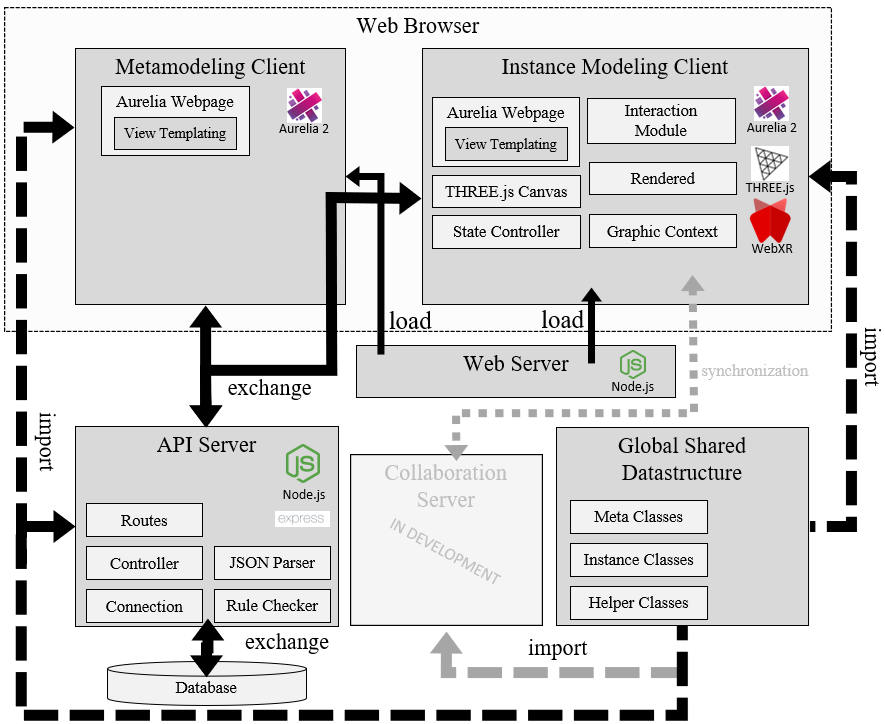
MM-AR: Metamodeling for Augmented Reality
A 3D-aware, web-based, open-source metamodeling platform for designing domain-specific modeling languages. It supports conceptual modeling in both 2D and 3D, enabling the specification of digital-twin-ready languages for collaborative robotics and Industry 4.0 scenarios. Implemented with Aurelia, Three.js and WebXR in a full-stack architecture, and extended with a PM4Py-based process mining service.
URDF-to-Action DSL for Collaborative Workcells
Collaborative project with the Smart Living Lab (EPFL) that links URDF models of robots and workcells to executable actions via a domain-specific language. A web-based 3D environment built with Three.js allows users to visualise the workcell, configure tasks and generate robot actions, bridging conceptual models, URDF structures and real robot behaviour.
Publications
Journal articles, conference proceedings and preprints on conceptual modeling, metamodeling, and robotics.
CMAG: A Framework for Conceptual Model Augmented Generative Artificial Intelligence
Fill, H.-G., Härer, F., Vasic, I., Borcard, D., Reitemeyer, B., Muff, F., Curty, S., Bühlmann, M.
Companion Proceedings of the 43rd International Conference on Conceptual Modeling: ER Forum, Special Topics, Posters and Demos (ER-Companion 2024), Pittsburgh, USA, CEUR-WS Vol. 3849, pp. 56–69, 2024
View PublicationState of the Art and Research Directions for Visual Conceptual Modeling in Robotics
Borcard, D., Fill, H.-G.
Enterprise, Business-Process and Information Systems Modeling (EMMSAD 2025), Vienna, Austria, LNBIP, Springer, pp. 415–430, 2025
View PublicationTowards Spatial Conceptual Modeling for Robotic Digital Twins Based on URDF
Borcard, D., Fill, H.-G.
PoEM2025: Companion Proceedings of the 18th IFIP Working Conference on the Practice of Enterprise Modeling: PoEM Forum, Geneva, Switzerland, CEUR-WS Vol. 4171, 2025
View PublicationMM-AR: A Web-Based Open-Source Metamodeling Platform for Spatial Conceptual Modeling
Muff, F., Borcard, D., Fill, H.-G.
Software and Systems Modeling (SoSyM), Springer, 2026
View PublicationSpatial Conceptual Modeling of Robotic Tasks in Virtual Reality Using Petri Nets
Feldmann, N., Borcard, D., Fill, H.-G., Curty, S.
Companion Proceedings of the 45th International Conference on Conceptual Modeling (ER-Companion 2026): Posters and Demos, St. John's, NL, Canada, CEUR-WS Vol. 4279, pp. 11–15, 2026
View PublicationExtending the MM-AR Metamodeling Platform with Process Mining Capabilities
Hürzeler, G., Fill, H.-G., Borcard, D.
arXiv preprint arXiv:2611.05176, 2026
View PublicationContact & Collaborations
I'm happy to discuss research collaborations, industrial projects, and supervision around conceptual & enterprise modeling, collaborative robotics, digital twins, and Industry 4.0.
Open to postdoc and visiting researcher opportunities, industry partnerships, and BSc/MSc student projects in these areas.
Location
Digitalization and Information Systems Group
University of Fribourg
CH-1700 Fribourg, Switzerland
Academic Profile
unifr.ch/inf/digits/en/group/team/daniel-borcard.html